Free shipping on orders over €59.

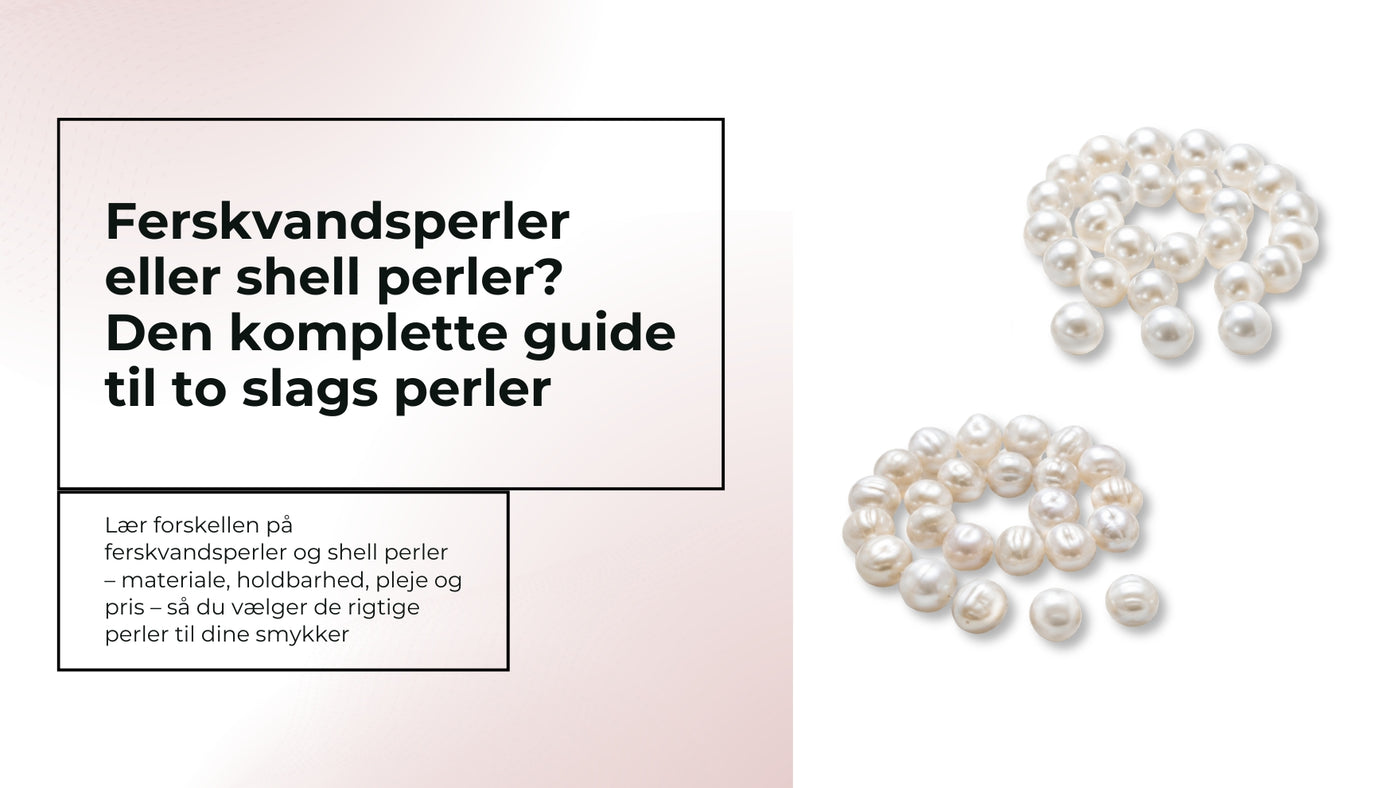
Freshwater pearls or shell pearls? The complete guide to genuine pearls and their beautiful imitations

In short: What is the difference between freshwater pearls and shell pearls?

Freshwater pearls and shell pearls often look alike on the shelf, but they are two very different things. Freshwater pearls are genuine pearls, formed in living freshwater mussels over several years and built up of solid nacre all the way through. Shell pearls, on the other hand, are beautiful imitation pearls: a perfectly round core of genuine mussel shell, coated with fine nacre powder so it mimics a real pearl. One is a nature-made gemstone with small, living variations – the other is a uniform, affordable and perfectly round alternative. In this guide, you'll get the full difference: how the two are created, how to tell them apart, what they can withstand, and which one best suits your particular project.


Are you standing with two strands of pearls in front of you that look alike at first glance – but where one costs significantly more, and the other is labeled "shell" – and are you unsure what the actual difference is? Then you're far from the only one. "Are shell pearls genuine pearls?" and "are freshwater pearls real pearls?" are among the questions we're asked most often here at Uniq Perler. And there's good reason for that, since the names resemble each other, the appearance can be quite similar, and the trade sometimes uses the terms somewhat interchangeably.

This guide is made for you, whether you're new to the world of beads or have been making jewelry for years. We'll calmly go through what the two types of pearls actually are, how they're created, how you can easily tell a genuine pearl from an imitation, and what each of them is best suited for. Along the way, you'll also get practical advice on thread choice, care and storage – and finally, answers to the questions we get most often. The goal is that afterward you can confidently choose the right pearl for your next piece of jewelry, without being in doubt about what you're getting.

What are freshwater pearls, really?

Freshwater pearls are genuine pearls in the full sense of the word. They form in living freshwater mussels, and today it's almost always a matter of cultured pearls – meaning pearls that arise with a little helping hand from humans, but which are still created by the mussel itself. "Cultured" doesn't mean artificial; it simply means that the process is set in motion under controlled conditions, instead of waiting for nature to randomly place a grain of sand inside a mussel.

What makes freshwater pearls truly special is that they consist almost entirely of solid nacre. The mussel builds up the pearl layer by layer of the same shimmering material that lines the inside of its own shell, and because a solid bead is rarely placed in the center, a freshwater pearl is essentially nacre all the way through. It's this quality that gives the pearl its deep, living glow – the light, so to speak, sinks into the surface instead of staying on top.

A pearl is created over a long period of time. The mussel is tended and fed in lakes or ponds for typically between two and seven years, depending on how large the pearl needs to be. By far the majority of the world's freshwater pearls come from China today, where freshwater pearl cultivation dates all the way back to the Middle Ages. It's a patient process, and it's part of the explanation for why a genuine pearl has a different character – and often a different price – than an industrially manufactured imitation.

Because each pearl is created in nature, two pearls from the same mussel will rarely be completely identical. There will always be small differences in shape, luster and surface, and that's exactly what makes natural pearls so beautiful and alive to work with.

How a freshwater pearl is formed

The formation itself is easier to understand when broken down into steps:

  • Insertion: A small piece of soft tissue from a donor mussel is carefully placed inside the host mussel. Often several pieces are inserted into the same mussel.
  • Growth: As a completely natural protective reaction, the mussel begins to lay thin layers of nacre around the inserted tissue – around the clock, month after month.
  • Maturation: The mussel is tended in freshwater for two to seven years, while the pearl slowly grows larger and gains depth in its luster.
  • Harvest and sorting: Finally, the pearls are harvested, washed, polished and sorted by hand according to size, shape, color and quality, before they become the strands you find in the webshop.

It's the same basic process behind all genuine pearls – the difference between freshwater and saltwater pearls is simply whether the mussel lives in a lake or the sea, and whether a solid core has been placed in the center.

What are shell pearls, really?

Shell pearls are something completely different, even though the name and appearance can be deceiving. They are not a type of pearl on par with freshwater or saltwater pearls, but rather imitation pearls – meaning pearls that are manufactured to mimic the appearance of a genuine pearl.

A shell pearl is built up around a core, which is usually cut and ground from real mussel shell, also known as mother-of-pearl. That core is ground into a perfectly symmetrical, round bead and is then coated layer by layer with a mixture of finely ground mother-of-pearl powder, color pigment and a binding agent. Between each layer, the surface is cured and polished until the pearl appears with an even, glossy, pearl-like shine. Because the core is made of real shell material, a shell pearl feels pleasantly heavy and "genuine" in the hand – but the shiny surface you see is a manufactured coating and not naturally formed mother-of-pearl.

Unlike freshwater pearls, shell pearls are manufactured in factories in large quantities, primarily in Asia. This means they can be made completely uniform, perfectly round and in exactly the color desired – from classic white and champagne to deep, dark and modern tones. This very uniformity is the shell pearl's great strength, and it is a key reason why many choose them for specific designs.

"Genuine pearl" or not – here's how it works

Here is the most important distinction, and it's worth having completely clear:

  • A cultured freshwater pearl is a genuine pearl. It is created by a living mussel, even though humans have set the process in motion.
  • A shell pearl is an imitation – even though the core is made of real shell. The key point is that the pearl-like surface is manufactured industrially and not formed by a mussel.

Worth knowing: In the trade, you sometimes come across shell pearls marketed under terms like "lab-grown pearls", "organic pearls" or "South Sea shell pearls". These names may give the impression that they are genuine or even exclusive pearls, but they only refer to the appearance – not the origin. If a pearl is built up from a coated core, it is an imitation, no matter how beautiful the name sounds. We always clearly state when a product is a shell pearl, so you know exactly what you're buying.

The Big Difference – Freshwater Pearls and Shell Pearls Side by Side

Before we dive into use, durability and care, here's a quick overview so you have the most important differences gathered in one place:

Criterion Freshwater Pearls Shell Pearls
What it is Genuine, cultured pearl from a living freshwater mussel Imitation pearl: a shell core coated with mother-of-pearl powder
How they are made Forms naturally inside the mussel over 2–7 years Manufactured industrially in a factory
Authenticity Genuine pearl Beautiful imitation of a pearl
Shape Organic, rarely completely identical – round, oval and baroque Completely uniform and perfectly round
Surface & luster Vibrant depth – light comes from within Smooth, glossy surface from the coating
Natural marks Small natural marks – a sign of authenticity Virtually none – completely uniform surface
Colors White, cream, pink, peach, lavender; darker tones are often dyed Any desired color – controlled through the coating
Durability with wear Solid mother-of-pearl – scratches simply reveal more mother-of-pearl Hard surface, but the coating can chip with heavy wear
Water & chemicals Withstands brief contact; damaged by acid, perfume and prolonged exposure to water Withstands water; damaged by alcohol, acetone and solvents
Hole size Often small, approx. 0.5–0.8 mm Larger and uniform, approx. 0.8–1.2 mm
Price level Varies widely depending on shape and quality Usually affordable and consistent
Best for One-of-a-kind jewelry, fine gifts, organic designs Matching sets, statement jewelry, uniform color series

Looking beyond the table, the difference essentially comes down to two completely different things. A freshwater pearl is a biologically created gemstone with small, natural variations and a depth in its luster that comes from within. A shell pearl is a uniform, industrially built alternative, where roundness, color and matching can be controlled with complete precision. Neither is "better" than the other – they are created for their own purposes, and the right choice depends entirely on what you intend to use the pearls for.

Så här skiljer du dem åt

When you hold the beads in your hand, there are a few simple signs that can help you determine what you're dealing with:

Shape and uniformity: If every bead on the strand is completely identical and perfectly round, it often points to shell beads. Freshwater pearls almost always have small differences from bead to bead – they are organic and rarely completely identical.

The surface around the hole: Take a close look at the drill hole. On a shell bead, you can sometimes see that the coating gathers slightly around the hole, or that it begins to flake a little at the edge over time. A freshwater pearl simply shows more mother-of-pearl if the surface gets scratched.

The luster: The freshwater pearl's luster has a soft depth, where the light seems to come from within. The shell bead's surface is often a bit more even and "painted" in appearance.

The rub test: Gently rub two beads against each other, or lightly stroke a bead against the edge of a tooth. A genuine freshwater pearl feels slightly rough or sandy due to the microscopic layers of mother-of-pearl, while a shell bead and a glass bead feel completely smooth.

None of the tests is a guarantee on its own, but together they give you a really good indication. And an important caveat: the fact that a bead is perfectly round and uniform doesn't in itself mean it's "worse" – it's just one of the signs that often comes with an imitation or a machine-calibrated bead.

About the natural marks

Because freshwater pearls are created in nature, you'll always be able to find small marks and variations on the surface. These aren't flaws, but signs that the pearl is genuine and naturally formed – each pearl carries, so to speak, its own little imprint of the mussel and the water it grew in. The higher the quality, the fewer and less visible the marks, but a genuine pearl will rarely be completely without them.

If you're after a surface without a single variation, that's exactly where a shell bead can be the answer – but in return, it doesn't have the same natural depth and character. It's one of the trade-offs that makes the choice your own.

Hållbarhet, vatten och skötsel

Both freshwater pearls and shell beads are soft, delicate materials compared to hard stones and glass, and they both need a bit of care. But they wear differently, and it's worth knowing when designing.

How freshwater pearls hold up

Freshwater pearls are surprisingly durable in the long run, precisely because they consist of solid mother-of-pearl. If the pearl gets a scratch, it simply reveals more mother-of-pearl underneath the surface, instead of exposing a different core. On the other hand, they are sensitive to chemicals and acid: perfume, hairspray, cosmetics, sweat, and cleaning agents can dull the luster over time.

The pearls can tolerate brief contact with clean water, but they should not be soaked, and they don't do well with chlorinated water or hot water over longer periods. A good rule of thumb is to put the pearls on last, after perfume and makeup are already in place.

How shell beads hold up

The shell bead's strength is its hard, even surface, which withstands knocks and daily use well. The weakness lies in the coating: if exposed to alcohol, acetone, nail polish remover, or strong solvents, the layer can crack, and with hard, sustained wear – for example, if the bead rubs against sharp metal edges – the coating can wear away or flake off over time and expose the core.

If the surface breaks first, you don't get a "softer" version of a genuine pearl, but a visible defect. That's why shell beads thrive best in designs where they don't rub hard against metal, and they must also be kept away from harsh chemicals.

How to care for your beads

Fortunately, daily care is simple and almost the same for both types:

  • Wipe the beads with a soft, lint-free cloth after use to remove skin oils and sweat.
  • If a more thorough cleaning is needed: use a cloth dampened with lukewarm water and a single drop of mild, pH-neutral dish soap, and gently dry afterward with a cloth wrung out in clean water.
  • Never use ultrasonic or steam cleaners – they are too harsh on both the mother-of-pearl and the coating.
  • If the beads are strung on thread, let the thread dry completely before wearing the jewelry again, so it doesn't stretch.
  • Store pearl jewelry separately in a soft pouch or a padded box, apart from harder stones and metal that can scratch. Freshwater pearls also benefit from a bit of air and should not be kept airtight in plastic for long periods, as they can dry out.

Så arbetar du med pärlorna

Because the two types of beads have different holes and different weight, there are a few technical things worth knowing when you put them together into jewelry.

Freshwater pearls often have relatively small holes, typically around 0.5 to 0.8 mm, so a fine thread suits them best. Genuine silk thread is the classic choice for knotted pearl strands, while a strong nylon thread or a thin, coated jewelry wire works well for modern jewelry. Shell pearls generally have larger and more uniform holes, often 0.8 to 1.2 mm, which makes them a bit more forgiving – here you can easily use a heavier thread or wire, which is also nice since shell pearls are often heavier.

A few good habits that protect your pearls:

Tie a knot between each pearl (a pearl knot) on knotted strands. This keeps the pearls from rubbing against each other and ensures they don't scatter if the thread should break.

Use French wire (bullion) at the clasp to protect the thread from wear where it bends around the clasp ring.

Choose nice jewelry findings with a soft design – lobster clasps, jump rings and pins without sharp edges, so the shell pearls' coating in particular isn't worn down.

For the actual stringing, a fine beading needle or a flexible twisted wire needle is a good choice – it glides easily through even the smaller holes in freshwater pearls.

What jewelry are they suited for?

Here the difference between the two types of pearls really shows, as each one is created for something specific.

Freshwater Pearls

Freshwater pearls come across most beautifully in necklaces, earrings, bracelets and pendants, where the natural glow and small variations are allowed to shine. They are especially well suited to one-of-a-kind jewelry and organic, modern designs, where the whole point is that no two pearls are exactly alike. They pair nicely with precious metals like sterling silver and gold-plated jewelry findings and with gemstones like amethyst and rose quartz. On the other hand, they are less suited to rings without a protective setting and to sturdy everyday bracelets that are exposed to a lot of knocks and frequent contact with soap.

Shell Pearls

Shell pearls are the obvious choice when you want lots of pearls that look exactly alike. They shine in classic, uniform pearl strands, in matching sets and in large statement jewelry, where perfect roundness, matching color and a bit of weight are an advantage. If you want to make a set with, for example, extra-large earrings or a tight, symmetrical strand in one particular color, shell pearls are both beautiful and economical to work with. They are less well suited to tightly woven bracelets and designs where the pearl rubs hard against metal, as this will wear down the coating over time.

Så väljer du rätt pärla

There's no single right answer – it depends on what you're making and the look you're going for:

  • If you want a genuine pearl with natural depth and character for a fine piece of jewelry or a special gift, freshwater pearls are the natural choice.
  • If you need many completely identical, perfectly round pearls in one particular color, shell pearls are both beautiful and budget-friendly.
  • If you're going for an organic, unique look where variation is part of the style, freshwater pearls are ideal.
  • If you're making large statement jewelry or matching sets where uniformity matters most, shell pearls look best.

A little pro tip: You can combine the two to great effect. A handful of genuine freshwater pearls as an eye-catcher – for example a center pearl – together with uniform shell pearls in the rest of the design gives a lovely result, where the natural and the uniform work together, while the overall piece is still kept within a reasonable budget.

One last thing worth knowing: the price difference isn't always as big as you might think. Freshwater pearls vary widely in price depending on shape, luster and quality, and simple freshwater pearls can be closer in price to shell pearls than many expect. Price alone therefore doesn't tell you whether a pearl is genuine – that comes down to the material and the way it was created.

Viktigt att komma ihåg

Freshwater pearls and shell pearls look alike at first glance, but they are created for different purposes. Freshwater pearls are genuine pearls, formed by living mussels, with a natural depth and small variations that make each piece of jewelry unique. Shell pearls are beautiful imitations, built up around a core of real mussel shell, and they stand out for their uniformity, their round shape, and their sensible price. Knowing the difference lets you choose wisely – and avoid the disappointments that arise when an imitation is mistaken for a genuine pearl, or when a delicate pearl is used for the wrong purpose.

At Uniq Perler we always clearly state what you're buying, and we select our pearls with care, regardless of type. If you choose genuine freshwater pearls, you can rest assured that each strand is thoughtfully sorted, and if you choose shell pearls, you get a beautiful and affordable alternative for the designs where a uniform look matters most. With the right care, you'll enjoy both for a long time. Now all you need to do is find the pearls that suit your next project.

Frequently asked questions about freshwater pearls and shell pearls

Är shell-pärlor äkta pärlor?

No. Shell pearls are imitation pearls. They are built up around a core of real mussel shell, which is coated with fine mother-of-pearl powder to mimic the look of a genuine pearl.

Although the core is made of natural shell material, the shiny surface is manufactured industrially and is therefore not formed by a living mussel.

Are freshwater pearls genuine pearls, then?

Yes. Freshwater pearls are genuine pearls, formed in living freshwater mussels. The fact that they are "cultured" simply means that the process is started under controlled conditions – the pearl is still built up by the mussel itself, layer by layer of genuine nacre.

How can I tell the difference between a genuine and an imitation pearl?

Look for three things: If all the pearls are completely identical and perfectly round, that points toward an imitation. If the coating gathers around the drill hole or flakes at the edge, it's a shell pearl. And if you do the rub test, a genuine freshwater pearl will feel slightly rough or sandy, while a shell pearl or glass bead feels completely smooth. Together, these three signs give a good indication.

Kan shell-pärlor flagna?

Yes. If a shell pearl is exposed to strong solvents such as alcohol or acetone, or to hard and continuous mechanical wear, the outer coating can crack or flake off over time, exposing the core.

Shell pearls should therefore be kept away from harsh chemicals and sharp metal edges.

Can freshwater pearls withstand water and bathing?

Only briefly. Freshwater pearls can tolerate a single splash of clean water, but they should not be soaked or exposed to hot water, chlorine, soap, and shampoo, as this will over time dull the shine and weaken the thread the pearls are strung on.

Therefore, take off pearl jewelry before showering or swimming.

Vad betyder en "barock" pärla?

A baroque pearl is a freshwater or saltwater pearl with an organic, irregular shape rather than the classic round one.

Baroque pearls are very popular precisely because of their lively, unique look, where no two pearls are alike.

Which thread is best for freshwater pearls?

For classic, knotted pearl necklaces, genuine silk thread is the traditional choice, as it drapes softly and leaves room for a knot between each pearl.

For modern jewelry, a strong nylon thread or a thin, coated jewelry wire works well. Because freshwater pearls often have small holes, the thread needs to be sufficiently fine.

Can freshwater pearls change color over time?

Natural, undyed freshwater pearls retain their color permanently when cared for properly.

If the pearls are dyed – which is often the case with very dark, gray, black, or strongly metallic tones – the color may fade slightly if exposed to strong, direct sunlight over a long period.

With normal use and storage, the color holds up well.

Tack för din tid!

I hope you learned a little something in today's blog post. If nothing else, I hope you found the post interesting.

It was lovely that you took the time to read along!

Andreas Bruhn

Uniq Perler

Leave a comment

Please note: comments must be approved before they are published.