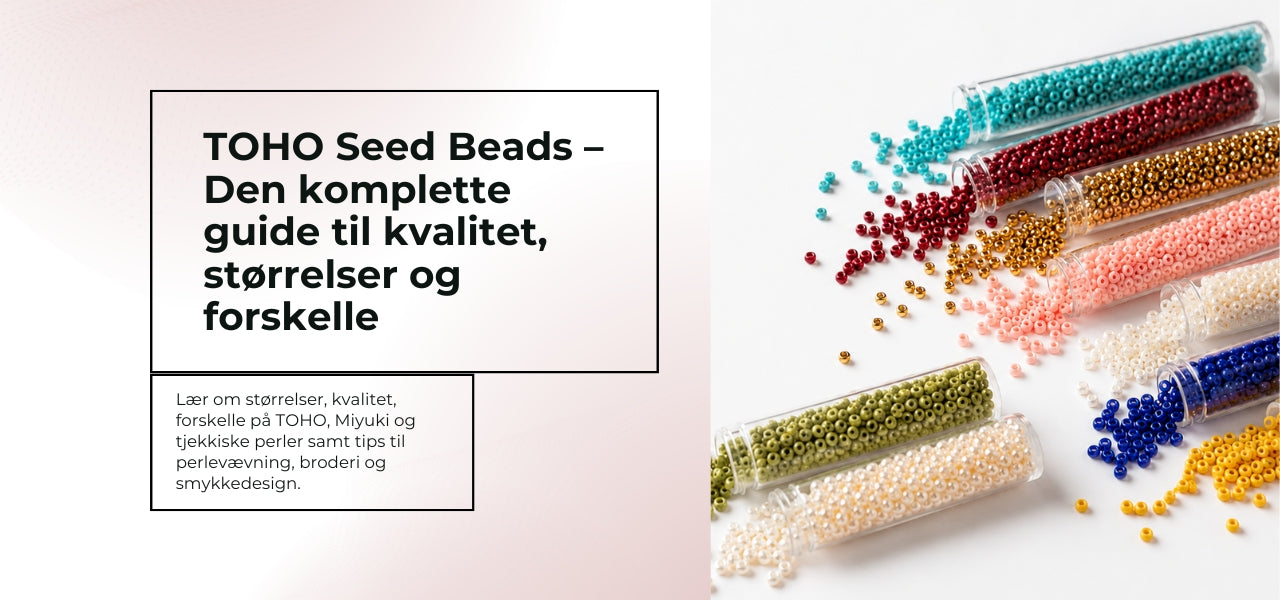
TOHO Seed Beads – The Complete Guide to Quality, Sizes, and Differences

In Short: What Are TOHO Beads?

TOHO beads are high-quality Japanese glass beads, known for their precision, uniform cylindrical shape, and large hole size. These glass beads, often called seed beads or rocailles, are produced in Hiroshima and make it easier to work with detailed techniques. Whether you're working with bead weaving, peyote patterns, or bead embroidery, TOHO's Japanese quality control ensures a neat, flat, and symmetrical end result.

For jewelry designers, textile artists, and hobby enthusiasts, the choice of materials is crucial to the aesthetics, durability, and structural quality of the final result. Within the world of glass beads – often referred to as seed beads or rocailles – there is a clear quality hierarchy that affects how even, strong, and beautiful a pattern can become. At the top of this hierarchy you'll find Japanese TOHO.

This guide serves as an in-depth reference to TOHO seed beads. It's made for you, whether you're a beginner or have many years of experience. We'll cover the beads' history, their geometric and physical advantages, the chemistry behind the surface treatments, and the differences between TOHO, Miyuki, and Czech glass beads. The guide also includes practical knowledge about choosing needles, thread tensile strength, and the types of projects where TOHO's quality truly comes into its own.

What Are TOHO Seed Beads?

Seed beads, most often called "rocailles" in Danish, are small, uniform glass beads used in a wide range of craft techniques – including jewelry making, bead weaving, kumihimo braiding, and bead embroidery. The term "seed beads" refers to the beads' modest size, which resembles small plant seeds.

TOHO seed beads represent a specific and refined branch of this glass tradition. Production takes place in Hiroshima, Japan, where the company TOHO Beads was founded in 1951. The founder Iwao Yamanaka, and later Kaoru Yamanaka, established the company with a vision of bringing color and beauty back after the war years. The name "TOHO" translates to "Eastern Treasure," reflecting the dedication to quality and craftsmanship.

The manufacturing process itself is an example of Japanese engineering. TOHO melts selected raw materials into glass at high temperatures. The molten glass is drawn out into long, thin glass tubes – known as "canes." These tubes are cut into millimeter-precise pieces using advanced machinery, after which they undergo a thermal polishing process that rounds off the glass edges and creates the finished bead. Continuous innovation means that TOHO is today one of the world's largest manufacturers of glass beads, with a range of over 10,000 variants.

The typical sizes range from 6/0 (the largest in the standard category) to 15/0 (the smallest), giving the designer a broad spectrum of design possibilities.

Why Are TOHO Beads So Popular?

The popularity of TOHO beads rests on one crucial parameter: Japanese quality defined by a high degree of uniformity. To understand the importance of this, think of a bead-woven piece of textile or a peyote pattern.

In techniques such as peyote stitch, brick stitch, right-angle weave (RAW), or when using a bead loom, each individual bead functions as a small "brick" in a larger structure. If the beads vary by a fraction of a millimeter in width, height, or shape, the finished pattern will start to warp, twist, or appear uneven. Working with irregular beads from lower quality grades requires you to constantly "cull" – an industry term for manually sorting out asymmetrical beads along the way. It's time-consuming and frustrating.

TOHO beads minimize this problem. Because each bead in a 10-gram tube has nearly the same dimensions, the same hole size, and the same finish, they slide effortlessly into complex patterns. The structural reliability means that a geometric design remains geometric, and that the lines in a woven bracelet become straight.

For beginners, the uniformity is important for the feeling of success. It makes it easier to learn difficult techniques, because the material "cooperates" with the design. For the experienced designer, it means time savings and a final product with a professional finish.

Teknisk parameter Tjekkiske perler (Preciosa) Miyuki (Round Seed Beads) TOHO (Round Seed Beads)
Hulstørrelse (11/0) Lille (ca. 0,6 mm) Standard (0,7 mm) Stor (0,8 mm)
Profil og form Afrundet "donut", organisk Afrundet, let flad "donut" Højere, rørformet/cylindrisk profil
Grad af ensartethed Lav til medium (kræver sortering) Meget høj (præcision) Høj (konsistent præcision)
Poseindhold Varierer (ofte 10-20 g) 4 gram 10 gram
Pris pr. pose (hos Uniq Perler) Føres ikke Fra 15 kr Fra 18 kr
Pris pr. gram ca. 1,50-2,50 kr/g* 3,75 kr/g 1,80 kr/g
Bedste anvendelse Stringing, frihåndsbroderi Flad peyote-vævning, pixel-art Broderi, mange tråde, wire, 3D-mønstre

*Tjekkiske priser er typiske detailpriser hos europæiske forhandlere. Data i tabellen er generelle industrigennemsnit baseret på tekniske målinger.

What Makes TOHO Different From Other Seed Beads?

Although there are several manufacturers of seed beads, TOHO has, through decades of research, produced a range of physical and technical characteristics that set them apart from both European and other Asian competitors. The differences are not just cosmetic – they change how the beads interact with beading thread, needles, and neighboring beads.

Larger Hole Size

The most important difference between TOHO and other bead brands is the size of the hole itself. Across all standard sizes, the hole diameter in a TOHO bead is larger than in an equivalent bead from competing brands.

If you compare, for example, an 11/0 bead from Miyuki with an 11/0 from TOHO, the hole size is 0.7 mm and 0.8 mm, respectively. The difference of 0.1 mm sounds insignificant, but it has real consequences for your work:

  • Room for more thread passes: In advanced bead weaving techniques (such as right-angle weave, bezeling of crystals, or fringe work), the needle and thread often need to pass through the same bead three, four, or up to six times. A larger hole reduces the risk of the glass bead cracking and lessens the friction that can wear through the thread.
  • Compatibility with thicker materials: The larger hole makes it possible to use thicker threads. It also opens up for materials such as fine leather cord, thick macramé cord, or stiff memory wire, which would otherwise not fit through a small 11/0 bead.
  • Lower weight means better value: Because a larger portion of the bead's volume is air (the hole itself), the bead contains slightly less glass mass. TOHO beads therefore weigh less per piece than beads with smaller holes. The result is that a standard 10-gram tube of TOHO beads typically contains more beads than a tube of the same weight from a Czech manufacturer.
Uniform, Cylindrical Shape

The combination of a larger hole and standardized outer dimensions gives a bead profile that is more cylindrical and has steeper sides than the classic rounded "donut" design from other European and Asian brands.

If you place a TOHO 11/0 rocaille next to other brands under magnification, you will see that the TOHO bead has slightly flatter outer sides and a bit more height (1.5 mm compared to, for example, Miyuki's 1.36 mm). The tube-shaped profile means that the beads lock together more tightly when sewn side by side. In weaving techniques and peyote stitch, the shape creates an almost fabric-like, smooth "bead textile" where the gaps (and the visibility of the beading thread) are minimized.

Strict Quality Control and Machine Precision

TOHO uses modern, computer-controlled machines for cutting and optically sorting their glass canes. The thermal polishing process is monitored with sensors to ensure that the surface becomes smooth and comfortable against the skin, without weakening or deforming the glass walls – which are precisely thin due to the large hole diameter. It is this Japanese quality control that consistently delivers predictable results.

Read our guide to Miyuki beads here as well

TOHO vs. Miyuki vs. Czech Beads

When you navigate the bead market, you will often need to compare the three major manufacturers: TOHO (Japan), Miyuki (Japan) and Preciosa (Czech Republic). A question we often get is: "What is the difference between TOHO and Miyuki, and are they really better than cheaper beads?" The choice depends on the specific project's requirements for shape, budget and expression.

Czech Beads (Preciosa)

Czech seed beads represent the old European glass tradition from Bohemia. They have a distinctly round "donut" shape with a relatively small hole. They are typically cheaper than the Japanese beads and are often sold on long strands (hanks) rather than loose in tubes.

  • Structural properties: Less uniform. You will experience varying widths and thicknesses within the same batch and color. The hole is smaller, which limits thread passages.
  • Ideal uses: Classic beaded necklaces strung on wire (stringing), traditional Native American handicrafts, "freeform" embroidery and projects where a boho-inspired expression is the goal. If you use them for flat, geometric weaving (like peyote), it will require a lot of sorting to avoid crooked patterns.
Miyuki Beads

Miyuki was founded in 1949 and is Japan's oldest manufacturer of seed beads. The Miyuki brand itself as we know it today was officially established in 1974. They are considered to be TOHO's primary competitor. Miyuki's round beads are slightly shorter in height and more rounded at the edges than TOHO's, giving the finished work a softer expression. They are very uniform in size.

  • Structural properties: High precision. Smaller hole than TOHO (0.7 mm in size 11/0) and more rounded edges on the round beads. Their tube-shaped specialty series, Miyuki Delica, is considered the industry standard for flat, pixelated patterns.
  • Ideal uses: Detailed flat patterns, peyote stitch and brick stitch, where mathematical symmetry and a smooth surface are important.
TOHO Beads

TOHO positions itself as the most flexible of the Japanese beads. The slightly greater height and the steeper, more cylindrical sides combined with the large hole make them a good hybrid between aesthetics and functionality.

  • Structural properties: Larger hole (0.8 mm in standard 11/0), making them more flexible to work with. Slightly more tube-shaped profile than Miyuki's round beads. At a microscopic level, they may in some opaque colors appear slightly more irregular in height than Miyuki, but they are superior in quality compared to Czech and Chinese beads.
  • Ideal uses: Bead weaving with many thread passages, bead embroidery on leather and textile, three-dimensional and complex stitches (such as Cellini spiral or Russian Spiral), as well as projects where the combination of precision and strength (through the use of thicker thread) is important.
Størrelse Diameter Hulstørrelse Antal pr. gram Bedst til
15/0 ca. 1,5 mm 0,4-0,6 mm 250-290 stk Detaljer, bezeling, picot-kanter
11/0 ca. 2,2 mm 0,7-0,8 mm 110-120 stk Universal standard, peyote, klassiske smykker
8/0 ca. 3,0 mm 0,9-1,2 mm 35-40 stk Macramé, kantsyninger, strikke- og hækleprojekter
6/0 ca. 4,0 mm 1,1-1,5 mm 15-18 stk Kraftige garner, statement-smykker, spacers

Husk: Jo højere tal, jo mindre er perlen. Antal pr. gram varierer afhængig af finish og farve.

Czech prices are typical retail prices at European retailers. The data in the table are general industry averages based on technical measurements.

Here's an interesting point: Even though TOHO is sold in larger bags (10 grams versus Miyuki's 4 grams), the price per gram is actually markedly lower at Uniq Perler – you get more than twice as many beads for your money compared to Miyuki. Combined with the advantage that TOHO has the largest hole and thus more beads per gram due to air volume, TOHO is a particularly attractive choice if you make larger projects or work with techniques that require many beads.

The conclusion is clear: All three brands produce high-quality materials, but they serve different technical needs. Czech beads win on the pure price per kilo, Miyuki wins on surface uniformity in the round beads, and TOHO wins on technical flexibility, thread capacity, innovation in formats – and in Uniq Perler's range also on price per gram.

Sizes of TOHO Seed Beads (Easy Explanation)

The sizing system for seed beads – internationally known as the "Aught" system – has historical roots and can seem illogical to beginners. Why is a size 15 smaller than a size 6? The rule of thumb is: The higher the number, the smaller the bead.

Historically, the number stems from the older production method and refers to how many beads of a given size could be placed side by side on an inch (2.54 cm). An 11/0 bead should, in theory, fill one inch if 11 of them were placed in a row. Although modern manufacturing techniques have adjusted bead dimensions slightly, and the rule of thumb no longer applies with complete precision, the nomenclature has been retained as the industry standard.

Here's an insight into the most common TOHO sizes:

15/0 (the ultra-fine micro bead)
  • Physical size: Approximately 1.5 mm in outer diameter.
  • Hole size: Approximately 0.4-0.6 mm depending on finish.
  • Count per gram: Approximately 250-290 beads per gram.
  • Characteristics: Very small beads that require patience and specialized thin needles (size 12, 13, or 15) and fine beading thread. Due to TOHO's large-hole philosophy, their 15/0 beads have a more tubular geometry than Miyuki's rounder 15/0, which affects how they fall in fine designs.
  • Use: Ideal for delicate and intricate design details, filling small gaps in textile embroidery, picot edges, and crystal settings (bezeling Rivoli crystals), where the bead needs to draw tightly around the stone.
11/0 (the universal standard)
  • Physical size: Approximately 2.2 mm in outer diameter.
  • Hole size: Approximately 0.7-0.8 mm.
  • Count per gram: Approximately 110-120 beads per gram.
  • Characteristics: The most popular and universal size across beading projects. 11/0 is the standard bead for nearly all published patterns in magazines and books. The hole in a TOHO 11/0 is large enough to let a needle and thick thread pass through multiple times without resistance, while the bead is still small enough for detailed patterns.
  • Use: Everything from peyote bracelets and necklaces to woven geometric pieces.
8/0 (the larger, tactile detail)
  • Physical size: Approximately 3.0 mm in outer diameter.
  • Hole size: Approximately 0.9-1.2 mm.
  • Count per gram: Approximately 35-40 beads per gram.
  • Characteristics: A good tactile size. For beginners who haven't yet developed the fine motor skills to handle the small 11/0 or 15/0 beads, 8/0 is a good entry point into beading.
  • Use: Often used as a base structure in complex twists, as edge stitching on leather, in coarser macramé knotting, cord jewelry, leather bracelets, or in knitting and crochet projects with thinner yarn, where the large 1.2 mm hole allows the yarn to pass through without damaging the fibers.
6/0 (the robust base and spacer)
  • Physical size: Approximately 4.0 mm in outer diameter.
  • Hole size: Approximately 1.1-1.5 mm.
  • Count per gram: Approximately 15-18 beads per gram.
  • Characteristics: Large, voluminous beads that are ideal for projects requiring visual weight and physical substance.
  • Use: Used for knitting with thicker wool yarn (DK weight), incorporating into kumihimo braids, paracord projects, and as decorative spacers between larger semi-precious stones or crystals in chunky statement necklaces.

The number of beads per gram will, in practice, vary slightly based on finish. Heavy metallic coatings (such as galvanized gold) and opaque colors weigh a little more than light, transparent colors.

Størrelse Diameter Hulstørrelse Antal pr. gram Bedst til
15/0 ca. 1,5 mm 0,4-0,6 mm 250-290 stk Detaljer, bezeling, picot-kanter
11/0 ca. 2,2 mm 0,7-0,8 mm 110-120 stk Universal standard, peyote, klassiske smykker
8/0 ca. 3,0 mm 0,9-1,2 mm 35-40 stk Macramé, kantsyninger, strikke- og hækleprojekter
6/0 ca. 4,0 mm 1,1-1,5 mm 15-18 stk Kraftige garner, statement-smykker, spacers

Husk: Jo højere tal, jo mindre er perlen. Antal pr. gram varierer afhængig af finish og farve.

Which projects are TOHO beads best suited for?

Seed beads are used for detailed designs and patterns due to their modularity. They function like pixels on a screen. The precision of TOHO beads and their enlarged holes open up a range of specialized applications that place high demands on the material's performance and durability.

Jewelry Design (bracelets, earrings and necklaces)

For jewelry making – such as fringe earrings, thick bead ropes like Cellini Spiral or Russian Spiral, as well as 3D flower and star motifs – TOHO beads are well suited. Their consistency ensures that threads can be pulled tight without deforming the pattern under tension. This is important for a wide, woven bracelet to lie flat and comfortably on the wrist, or for an earring fringe to fall evenly.

Advanced Bead Weaving

Bead weaving on a bead loom is a technique that requires regular beads. If the beads vary slightly in width, the horizontal rows will start to bow up and down, and the finished bracelet will look unprofessional. TOHO's cylindrical series (Aiko and Treasures) are developed for exactly this discipline. Here, the flat cylinders sit side by side like microscopic bathroom tiles, forming a "fabric" of glass with an almost silky texture. The round 11/0 beads also work well on the loom, but they give a bit more texture to the surface due to their profile.

Bead Embroidery

Embroidery with small beads directly onto textiles (such as designer bags, jackets or stiff backings for setting cabochon stones) is an area where TOHO truly dominates. In embroidery, beads must be sewn onto an often stubborn surface (such as Ultrasuede, felt or leather), and to secure the work, a locking thread is often pulled back through the same row of beads several times. TOHO's enlarged hole allows the use of thicker needles and repeated thread passes without the glass wall cracking.

DIY Projects and Mixed Media

The combination of TOHO's larger sizes (primarily 8/0 and 6/0) with knitting and crochet is popular, because the bead's large hole size allows thinner wool or cotton yarn to be pulled through without the yarn fraying or getting stuck. In addition, they work well in knotting techniques like macramé and in home decor (such as Christmas ornaments and Easter eggs), where they contribute color texture, reflection and weight to the finished design.

Which type of TOHO bead should you choose?

When you venture into TOHO's range, you quickly discover that "a bead" isn't just "a bead." Choosing the right bead should be based on three factors: the physical shape (Shape), the glass type and color (Color), and the surface treatment (Finish). Each of these elements affects both the working process and the durability of the finished project.

Breakdown by Shape (Shape and Structure)
  • Round (Rocaille): The classic, slightly round and plump bead shape. It's the workhorse for most beading techniques, embroidery and stringing work.
  • Cylindrical Beads (Treasure & Aiko): TOHO Treasures are cylinder beads (comparable to Miyuki Delica, though with a fraction larger diameter), which provide a smooth and even surface, perfect for flat weaving. Their flagship, TOHO Aiko, is considered "the perfect cylinder bead." The Aiko beads are the result of machine-cut precision. They are locally certified as a masterpiece of craftsmanship (under the "Hiroshima Brand" label). They are designed with one purpose: to deliver flawless woven surfaces without requiring "culling" (manual sorting) before work.
  • Takumi LH (Large Hole): A newer innovation from TOHO. Here, a bead with the same outer dimensions as the classic 11/0 round has had its inner hole enlarged by 15% (0.9 mm instead of 0.8 mm). This creates design possibilities for threading thick leather cords or fabric threads through small, elegant beads, giving the finished piece stiffness and strength.
  • Demi Round: Thinner, disc-like versions of the round beads. They retain the same outer diameter and large hole as an 11/0, but are physically only a fraction of the height. They work well as elegant "spacers" between other materials and can create complex and textured layers in the jewelry piece.
  • RE:Glass: An eco-friendly innovation. RE:Glass beads are made from recycled glass bottles. They retain TOHO's machine precision, but due to the source material, they have a more muted, matte, organic and "sea-glass" appearance, which suits nautical and bohemian-inspired designs.
Breakdown by Glass and Color (Color)

The chemistry within the glass body itself determines the bead's fundamental color profile and light transmission, independent of what it is subsequently coated with in terms of lacquer or metal.

  • Opaque: Solid, fully colored glass with no light penetration. Gives bold, striking color surfaces, such as solid red, glossy black or chalk white. These beads often weigh slightly more than transparent beads, which is important to remember in material calculations.
  • Transparent: Light can pass through the glass. This creates a light, vibrant and jewel-toned effect that beautifully catches and refracts light, especially in sunlight.
  • Color-Lined / Silver-Lined: A combination. A transparent or lightly tinted outer glass is combined with an interior (the core of the hole itself) that is strongly colored or lined with foil of silver or 24k gold. It reflects light from the inside out, creating a "glowing" or sparkling 3D effect from within the bead's interior.
Breakdown by Finish (Surface Treatment and Durability)

The outer surface treatment affects how light is refracted in the jewelry piece, and how resistant the bead is over time when in contact with skin and environment.

  • Matte (Frosted): Here the outer glass is chemically etched or mechanically ground. This removes the glass gloss and leaves a soft, almost velvety surface. Matte finish is popular in modern, subdued Scandinavian designs, and since the color is in the glass and not a coating, there is no risk of it flaking off or losing color.
  • Luster: A permanent, transparent surface sheen, often combined with a pearlescent shimmer, that is baked onto the outside of the glass. This makes the bead look constantly moist, shiny or slightly metallic.
  • Metallic & Galvanized (The Important Distinction): Highly metallic finishes are almost always applied to the outside of the glass bead itself through an electro-chemical galvanizing process. The classic challenge with ordinary galvanized beads (both for standard TOHO and standard Miyuki) has been that friction from clothing, reaction with the skin's natural pH level (sweat), as well as contact with perfume and lotion can cause the gold, silver or copper color to wear off, leaving a dull glass bead.

To solve this problem for jewelry designers, TOHO created their PermaFinish (PF) (Miyuki calls their equivalent lacquer Duracoat). PermaFinish is a strong and invisible lacquer coating and sealant, applied over the galvanized surfaces, which increases durability and minimizes color transfer. For jewelry that will be worn directly against the skin and experience daily friction (such as rings and tight bracelets), it is recommended to invest in the PF series if you want a metallic color that lasts for many years.

Tips for working with TOHO beads

Buying the right beads is only half the process behind a successful jewelry project. The tools and techniques the beads are combined with are also important for success and enjoyment of the work. An understanding of the interplay between thread, needles, and the glass bead's geometry is essential for any designer.

Use thin, precise needles

The needle is your most important tool. It must not only be able to pass through the bead's hole – it often has to do so along with several layers of thread without getting stuck and splintering the glass.

For TOHO 11/0 beads, it is recommended to use specific "beading needles" in size 10, 11, or 12. Quality brands such as Japanese Tulip needles or BeadSmith Speedle needles are recommended. They are able to bend and adapt to tight passages without breaking, and their eye stays intact even under pressure from the thread.

For the very small TOHO 15/0 beads, where the hole diameter in some cases approaches 0.5 mm, it is important to use an ultra-thin needle, typically in size 12, 13, or down to size 15. This prevents the glass wall from being subjected to internal pressure and bursting during work. Split needles (needles that can open in the middle) can be used to thread thicker leather cords or elastic, but these needles deform quickly and are not suitable for finer, repeated, and tight weaving.

Use quality thread

The lifespan of a piece of jewelry is rarely longer than the thread it is sewn with. Different types of thread interact differently with the glass edges inside the bead.

  • TOHO One-G: This nylon thread is developed by TOHO to work optimally with their own glass beads. It resembles the classic Nymo (size B) in thickness and profile, but the One-G thread is coated with a surface treatment (an anti-tangle agent) that prevents it from tangling, knotting, or fraying during repeated pulls through the beads. It falls softly and is ideal for moving elements such as fringes and weaving, where you want "drape" (a soft, fabric-like fall).
  • Miyuki Beading Thread / KO thread: Also high-quality nylon threads that behave similarly to TOHO One-G. They are lightly pre-waxed, resistant to surface fraying, and well suited for flat peyote stitch, where the thread must not take up too much space.
  • Fireline / Wildfire: Unlike nylon, these threads are braided and heat-treated polyethylene (originally developed as a durable fishing line), and they are among the strongest options on the market. The primary advantage is that they do not stretch at all (zero stretch) and cannot be scratched through by any sharp bead edges (which you may experience on the inside of cheaper Asian beads or crystals). Fireline is more expensive per meter than regular nylon thread and is stiffer. It is typically used for projects that require structural rigidity (such as boxes sewn in peyote or bezeling large stones), but it is not recommended for long earring fringes, as the thread lacks the natural softness and elasticity of nylon. A variant such as 6LB (pound) Fireline is the most popular on the market; it is thin enough to pass through a TOHO hole several times, but hard to break with bare hands.
Sort beads (if necessary)

Although TOHO represents a high industrial standard, it is still recommended for most of their product lines (with the exception of the precise Aiko series) to perform a quick "culling" during the beadwork itself. This is done by pouring the beads out onto a soft surface (for example a "bead mat" that prevents them from rolling away) and discarding the few beads that appear asymmetrical, too narrow, or abnormally short/long. This small step takes seconds, but it ensures flat weaving and prevents you from having to cut the work open later because of one bad bead in the middle of the design.

Storage

Proper organization and storage is key to a good working environment. It is important that you store the Japanese seed beads separately from other brands. Because of the size difference between TOHO (where 11/0 is approximately 2.2 mm and has a large hole) and Miyuki (where 11/0 is approximately 2.0 mm and has a slightly smaller hole), unknowingly mixing these in the same pattern row can ruin the proportions of an otherwise complex design.

You should store them in their original plastic tubes, or clearly label your own sorting boxes with brand, size, surface type (for example PermaFinish), and the unique color code, so the same bead can easily be repurchased when you run out. In addition, closed, dark storage in tubes protects against moisture and oxidation, which can affect unprotected, cheap galvanized coatings if left out in the open.

Are TOHO beads worth the money?

When materials are assessed in the hobby and craft sphere, the real cost isn't measured only by the initial price per kilo of glass, but by the long-term value. Czech or Chinese mass-produced, uneven beads are cheaper to buy per gram. But the hidden cost arises in the work process itself and the lifespan of the piece of jewelry.

A jewelry project – such as a fully woven bracelet or a beaded collar – can take ten, twenty, or up to fifty hours to produce by hand. If you use irregular, uneven beads for such a project, some of those hours will be spent sorting out misshapen beads ("culling") – and despite the effort, the end result will in many cases still end up looking crooked and uneven. Worse still is when the galvanized gold or silver color on a piece of cheap glasswork fades, oxidizes, or flakes off after just two wears against the skin. When that happens, the entire time investment is lost.

TOHO seed beads are an investment in the craft itself. The larger hole means there is less glass per bead. The lower volume results in you getting more beads per purchased gram compared to the heavier beads with small holes from competing manufacturers. The Japanese consistency respects the designer's time by enabling fast progress in the pattern, and TOHO's PermaFinish line ensures that the metallic colors survive everyday wear and sunlight for many years.

At Uniq Perler, TOHO beads are also very competitively priced. A 10-gram bag starts from 18 kr, which corresponds to approx. 1.80 kr/gram – significantly cheaper per gram than Miyuki Rocailles, even though both are Japanese premium beads. This makes TOHO an obvious choice, both when you're learning the techniques as a beginner, and when you need to produce larger projects without your budget spiraling out of control.

Conclusion

TOHO seed beads stand as an important name within global glassmaking and modern jewelry design. The precision-cut Japanese glass beads bridge centuries-old glass traditions with modern mechanical technology, and they meet both the initial needs of the beginner and the more advanced demands of professional jewelry making.

Their signature – the enlarged hole size – creates a more versatile and time-saving working experience, where thicker thread and repeated needle passes are accepted without crushed beads. This detail also changes the bead's outer profile to be slightly more tubular and cylindrical, providing precision in flat weaving and stitching techniques. Whether you use the voluminous 6/0 beads for yarn and knitting projects, the universal 11/0 for classic jewelry, or the precise Aiko beads for textile-like pixel art and weaving, TOHO is a guarantee mark of consistency.

They are a great choice for beginners who need a forgiving material to learn the basic techniques without frustration, as well as for the experienced designer who demands durability through, for example, the PermaFinish series. Switching from uneven discount beads to a quality product like TOHO is often the most important step a dedicated designer can take to elevate their work from a leisure hobby to a lasting piece of craftsmanship.

To begin your next beading project and take advantage of all these benefits, you can explore our TOHO range here on the site. By choosing the right beads, you lay the foundation for a piece of jewelry that lasts for many years.

FAQ: Frequently Asked Questions About TOHO Beads

What Are TOHO Beads?

TOHO beads are small, high-precision glass beads (often called "seed beads" or "rocailles") manufactured in Japan. They are known for their mechanical consistency, color quality, and the characteristic large hole relative to the bead's outer diameter. They are made by the TOHO Beads company (founded in Hiroshima in 1951) and are primarily used for jewelry making, bead weaving, and embroidery on textiles.

Is TOHO Better Than Miyuki?

"Better" depends on the specific technique you want to use and your personal preference. Both brands are leading Japanese manufacturers. Miyuki is known for a flat, rounded shape (in their round series) and for the precision of their tubular Delica series. TOHO differs by having a steeper, more cylindrical profile, a noticeably larger through-hole, and by being more technically flexible for intricate projects where many thick threads need to pass through the same spot (such as in thick fringes, tassels, or spiral patterns). They are both excellent, but suited to slightly different technical needs.

Are TOHO Seed Beads the Same as Miyuki Beads?

No. They are two different Japanese brands, but they both deliver beads of absolute top quality. The difference lies primarily in the fact that TOHO beads most often have a larger hole in the middle and can appear slightly wider than Miyuki beads of the same stated size.

Which TOHO Bead Size Should I Choose?

Remember the basic rule: The higher the number, the smaller the bead.

  • Choose size 15/0 (approx. 1.5 mm) for small details, bezeling (setting stones) and the finest finishing work.
  • Choose size 11/0 (approx. 2.2 mm) as your versatile standard size. It fits almost all types of patterns and classic jewelry.
  • Choose size 8/0 (approx. 3.0 mm) for eye-catching statement jewelry, macramé, edge stitching, or if you're a beginner and need a more tactile bead.
  • Choose size 6/0 (approx. 4.0 mm) for thicker yarns, knitting projects, thick leather cords or large lace-up bracelets.

Why do my beads lose their color, and how do I avoid it?

Cheaper, mass-produced beads and certain metallic/galvanized surfaces (Galvanized) can lose their finish. This happens through chemical and physical contact with the skin, the body's acid, sweat and wear (friction from clothing). The degradation happens quickly if the metal layer sits loosely and unprotected on top of the glass. The solution is to choose TOHO beads with the designation "PermaFinish" (PF). This chemical coating and sealing protects the underlying metallic or colored surface and ensures the beads' durability for many years, even with daily use. Another safe choice is beads made of glass types labeled as "opaque" (color throughout the glass mass itself), as the glass itself cannot lose color, fade or wear off.

What is the difference between a regular TOHO 11/0 and TOHO Takumi LH?

They share the same outer diameter and shape (approx. 2.2 mm), which makes them visually identical, but "Takumi LH" (Large Hole) is manufactured with an inner hole that is 15% larger in radius (0.9 mm instead of 0.8 mm). Takumi LH enables the use of thicker mounting materials (such as leather cords, memory wire or elastics) in fine jewelry designs, without you having to move up to the visually larger 8/0 bead size. This optimizes the creative building process and the ease of design.

Thank you for your time!

I hope you learned a little something in today's blog post. If nothing else, I hope you found the post interesting.

It was lovely that you took the time to read along!

Andreas Bruhn

Uniq Perler

Leave a comment

Please note: comments must be approved before they are published.