Shipping is calculated at checkout.

Cat Eye or Selenite? The Complete Guide to Two Beautiful but Vastly Different Beads

In Short: What Is the Difference Between Cat Eye and Selenite?

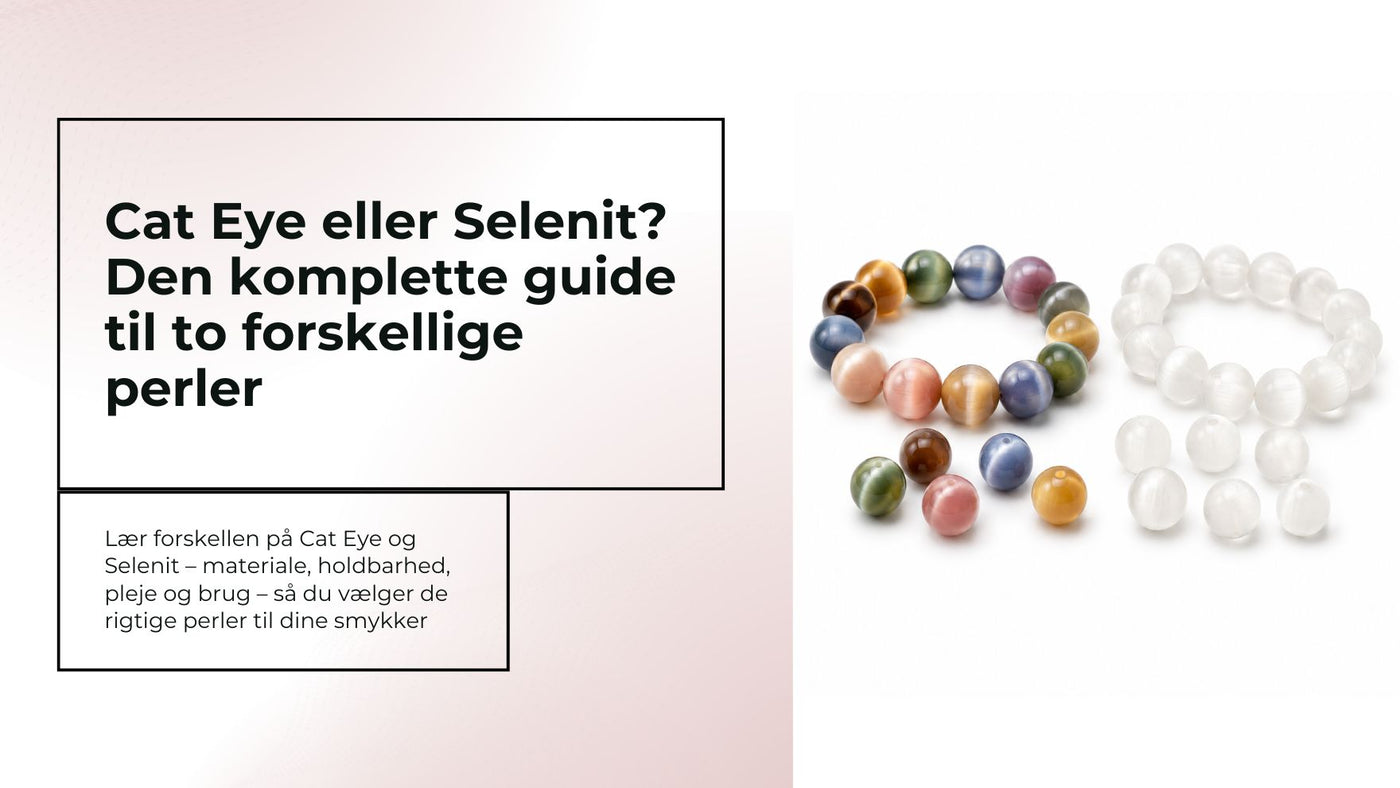
Cat Eye and Selenite share the same dreamy, gliding streak of light across the surface, but behind the shine hide two entirely different materials. Cat Eye is usually man-made fiber optic glass – sturdy, waterproof, and available in all the colors of the rainbow, making it perfect for everyday jewelry. Selenite, on the other hand, is a soft, naturally formed mineral (a type of gypsum) that cannot withstand water and is best suited for delicate earrings and pendants worn with a bit of care. In this guide, you'll get the full picture of the difference: how the two beads are formed, how to tell them apart, what they can withstand, and which one best suits your particular project.

Are you standing by the bead trays with two shimmering beads in your hand that look identical, but that you have a feeling are worlds apart? Then you're far from alone. Cat Eye and Selenite are among the beads we're asked about most often here at Uniq Perler – and for good reason. At first glance, they look alike with their soft, silky streak of light, but they could hardly be more different when it comes to what they're made of, how they should be cared for, and what they're suited for.

This guide is made for you, whether you're new to the world of jewelry or have been making jewelry for years. We'll calmly go through what the two materials actually are, the science behind the fascinating streak of light, how to tell genuine selenite apart from fiber optic glass, and which project types each bead is designed for. Along the way, you'll also get practical advice on thread selection, protecting the soft beads, care and storage – and finally, answers to the questions we get asked most often.

The goal is that afterward you can confidently choose the right bead for your next piece of jewelry, whether you're dreaming of a sturdy everyday bracelet in bold colors or a delicate, natural pair of earrings.

Vad är Cat Eye-pärlor?

When we talk about "Cat Eye" in the world of beads, we're actually not talking about one particular stone from nature, but about an optical effect. Experts call the effect chatoyance, and the word comes from the French chatoyer, meaning "to shine like a cat's eye". The effect appears as a narrow, sharp, glowing band that floats across the bead's curved surface and moves when you tilt the bead in the light – exactly like the pupil of a cat's eye contracting to a thin slit in bright sunlight.

The phenomenon itself occurs because the material contains an incredible number of tiny, parallel threads or fibers. When light hits them, it gathers and is reflected back as one sharp line running across the direction of the fibers. The closer together and more uniform the fibers are, the sharper the band of light becomes. That is precisely why a well-cut Cat Eye bead has such a clear and clean "eye".

Natural Cat's Eye Effect or Fiber Optic Glass?

The cat's eye effect occurs both in nature and in man-made materials, and this is where many people become uncertain.

In nature, the effect can appear in several different gemstones, if the crystal has grown with the right parallel fibers inside it. The most famous and precious is chrysoberyl, which is actually the only gemstone that, in professional terminology, may be called "Cat's Eye" with no prefix at all. Tiger's eye, apatite, and tourmaline can also carry the effect. In the finest natural stones, an extra, beautiful illusion called "milk and honey" can sometimes be seen, where the stone divides into a light and a dark half that swap places when you turn it.

But the vividly colored Cat Eye beads you find with us and most other bead retailers are almost always something entirely different: they are made of fiber optic glass. That is the reason they come in such pure and intense colors – from deep royal blue and neon pink to the most delicate pastels – and why the band of light is so sharp and uniform from end to end.

How Fiber Optic Glass Is Made

It sounds technical, but the story behind fiber optic glass is quite fascinating – and it explains why the beads look the way they do. The material is, in fact, related to the technology originally developed to send light and data through optical fiber cables in the telecom industry.

It starts with pure glass, which is drawn out into long, hair-thin fibers – so thin that more than a kilometer of fiber can be drawn per minute. Thousands, indeed millions, of these microscopically thin glass fibers are then bundled together extremely tightly and fused into massive blocks. During the fusing process, color pigments are added, and that is what gives the wide, even range of colors. Finally, the blocks are cut and ground into round beads, drops, hearts, or coins.

Because the fibers lie so closely and so perfectly parallel, together they act like a fine-meshed grid that casts an unusually sharp and completely uniform band of light. That very uniformity is the biggest difference between the man-made glass and a natural stone: where nature always has small irregularities, the fiber optic glass is even all the way around. That gives a clean, predictable, and vividly colored bead – and at the same time a durable material, as we'll see shortly.

Vad är Selenit?

Where Cat Eye is most often man-made, Selenite is entirely nature's own work. Selenite is a beautiful, crystalline form of the mineral gypsum, and the name comes from Selene, the Greek moon goddess. Once you see the pearl's milky-white, soft sheen, you quickly understand why – the light flows almost like liquid moonlight across the surface.

Selenite is one of the most widespread minerals of its kind and is found in large deposits all over the world, including in Morocco, Mexico, the USA, Australia and Greece. It forms over incredibly long periods of time in dried-up salt lakes and shallow ocean bays, where mineral-rich water slowly evaporates and leaves the crystals behind, layer by layer. In some places, this has happened on such a grand scale that it has created true natural wonders – like the famous crystal cave Cueva de los Cristales in Naica, Mexico, where selenite crystals have grown several meters long.

Satin spar, true selenite and the other forms

This is where it gets interesting, because "selenite" actually covers several different expressions of the same mineral, and the names are often used somewhat interchangeably in trade. It's good to know the difference:

  • True selenite refers to the large, flat and almost completely transparent slabs that resemble ice or glass. They are so clear that in Roman times and in medieval churches, they were actually used as a kind of window glass.
  • Satin spar is the fibrous, silky version with the soft band of light. It's precisely this form that has the fine cat's-eye-like shine – and it's almost always satin spar that's used for the polished selenite beads, spheres and wands you find in jewelry and crystal shops.
  • Desert rose refers to crystals that have grown together with sand grains into something resembling clustered rose petals.
  • Alabaster is a fine-grained, solid form that has been used for sculptures and carvings since antiquity.

All the forms have exactly the same chemical composition – the difference lies in how the crystals have grown. So when we talk about "selenite beads", we're technically most often referring to satin spar. The term "selenite" has simply become the one everyone uses, and the one most people know the material by.

This is why Selenite is so soft and delicate

To design wisely with selenite, it's important to understand why the material is the way it is. Selenite is formed from gypsum, and hidden within the crystal structure itself are small water molecules that are only loosely bound. This is the fundamental reason why selenite is one of the softest materials you'll ever encounter in the world of jewelry.

On the hardness scale from 1 to 10 – the so-called Mohs scale – selenite lands at just 2. By comparison, an ordinary fingernail sits at around 2.5, which means you can literally scratch the bead with your nail. Selenite also has a distinct tendency to split and flake into thin layers if it receives a hard knock, because the crystal easily cleaves in one particular direction.

It's important to note that this is not a flaw in your particular bead – it's entirely natural for the material, and part of what makes selenite so alive and beautiful. It just means you design a little differently with selenite than with hard beads, and we'll return to that further down.

The Big Difference – Cat Eye and Selenite Side by Side

Before we dive into use and care, here's a quick overview so you have the most important differences gathered in one place:

Property Cat Eye (Fiber Optic Glass) Selenite (Satin Spar)
Origin Man-made glass, melted from thousands of thin glass fibers 100% natural mineral (gypsum), formed in nature over millions of years
Appearance Sharp, glossy stripe of light. Available in every color – from neon to soft pastels Soft, silky glow in natural shades such as white, peach and warm orange
Hardness Fairly hard and sturdy (around 5–6 on the Mohs scale) Very soft (only 2 on the Mohs scale) – can be scratched with a fingernail
Durability in use Withstands everyday wear and knocks well Delicate – can scratch, flake and crumble with wear and friction
Water resistant? Yes, fully waterproof – can be worn in the shower and pool No – slowly dissolves in water and loses its shine
Best for Everyday bracelets, children's jewelry and bold designs Earrings, pendants and jewelry for special occasions
Care Wash in lukewarm water with mild soap Wipe with a dry, soft cloth – never water

Looking behind the numbers, the difference is essentially about two completely different types of material. Cat Eye is inorganic glass that has been melted together at very high temperatures into one solid mass. Selenite is a soft, water-containing crystal with loose bonds. That's why they behave so differently when worn: a selenite bead will over time lose its polish, simply by rubbing against clothing, skin or other beads, while a glass bead retains its smooth, glossy surface for years under the same conditions.

This is exactly why it's so important to choose the right bead for the right piece of jewelry. If selenite is used for, say, a bracelet worn every day, the customer will find that the stone becomes dull and worn – not because there's anything wrong with the bead, but because the material simply isn't made for that kind of wear. With that knowledge in hand, you can design so that each material is shown at its best.

Durability, Hardness and Water – What Does It Mean in Practice?

The two most important properties to keep in mind when choosing between Cat Eye and Selenite are hardness and water resistance. Both have a direct impact on where and how the jewelry piece can be used.

Hardness and wear

Cat Eye made of fiber optic glass sits in the middle of the Mohs scale, around 5-6. This makes the beads sturdy enough to withstand the friction and small knocks of everyday life – the wrist against the desk, beads against each other, contact with clothing. They keep their glossy surface for a long time.

Selenite, as mentioned, sits all the way down at 2 and therefore scratches easily – by harder stones, by metal, and even by a fingernail. This doesn't mean selenite can't be used in jewelry; it simply means the beads need to be protected from wear and placed where they hang freely.

Are they water resistant?

Here the difference is especially significant, and it's worth knowing, both for you and for your customers.

Cat Eye is completely waterproof. The glass is unaffected by moisture, sweat, or soap, and the beads can safely be worn in both the bath and the pool. Combine them with waterproof jewelry findings, and you get a piece of jewelry that can go anywhere.

Selenite, on the other hand, is very sensitive to water. Because the material is a form of gypsum, it slowly dissolves on contact with water: the surface becomes rough and matte, and over time small thread-like fibers can loosen. Selenite jewelry must therefore never be rinsed under the tap, taken into the shower, or into the sea, and it also cannot withstand ultrasonic cleaners or chemical cleaning agents. The good news is that it's easy to account for – you simply take the jewelry off before going into water.

Which projects suit the two beads?

Because the two materials are so different, they come into their own in different kinds of jewelry. Here's how we recommend using them.

Bracelets and everyday jewelry

For bracelets worn daily, Cat Eye is an obvious choice. Because the beads are made of solid glass, they easily withstand the constant friction against tables, keyboards, and sleeves. They work well on elastic, jewelry wire, and a heavier steel wire (for example a flexible tiger tail wire in 0.45-0.50 mm), and they are sturdy enough to also be used in children's jewelry.

Selenite, on the other hand, we would generally advise against for everyday bracelets. If you do want to use it for everyday wear, remember to wear it with care. The beads scratch quickly, and sweat from the wrist gradually makes the surface matte. If selenite is to be used in a bracelet after all – for example because of the stone's calm aura – it's a good idea to let the customer know that the piece is intended for special occasions rather than daily wear.

Earrings and pendants

Selenite truly comes into its own in earrings and as pendants on necklaces. Here the beads hang freely and protected, and are rarely exposed to direct knocks or friction, so the beautiful, silky surface gets to keep its shine. Both ear studs and long pendants suit the material.

Cat Eye naturally also works well in earrings and necklaces, and with the wide range of colors you can hit exactly the look you're going for.

Waterproof jewelry

If you want to make jewelry that can withstand water, Cat Eye is the way to go. Combine the waterproof glass beads with waterproof jewelry findings in surgical steel or gold-plated steel, and you get "can-handle-anything" jewelry that can safely be worn in the shower and pool without taking damage. That's a really good feature to highlight if you resell your jewelry.

Combining with other materials

The two beads pair beautifully with different kinds of materials:

  • Cat Eye suits waterproof jewelry findings in steel and gold, and creates a striking contrast with small Japanese Miyuki and Toho beads (seed beads) if you want a more detailed, graphic, or modern look.
  • Selenite harmonizes with oxidized silver, genuine freshwater pearls, and soft pastel crystals such as rose quartz, peach moonstone, amethyst, and aquamarine. It supports the ethereal, romantic, and boho-inspired look that selenite naturally invites.

How to work with Cat Eye and Selenite

Choosing the right beads is only half the job – the way you assemble the jewelry matters just as much for how long it lasts. Selenite in particular requires a little extra thought at the work table.

Thread choice

Cat Eye is easy to work with and tolerates most materials, both elastic, jewelry wire and wire. Here you don't need to think about special protection.

Selenite is more delicate, and here the most important technical detail is to avoid internal friction. If you pull soft selenite beads directly onto bare steel wire, wedged tightly against each other or against sharp metal parts, the metal will over time wear the bead hole apart from the inside. Choose instead a softer solution – for example a pure silk thread or a strong, soft nylon cord – where you can tie a small knot between each bead.

Protect the soft beads with spacers

A single trick makes a big difference to the durability of selenite jewelry: place a small shock absorber between the beads. This can be a soft knot on silk thread, a single smooth seed bead in size 11/0 or 15/0, or a small smooth spacer in soft material. This way you avoid the soft selenite beads rubbing hard against each other and against the metal parts, and the jewelry lasts far better.

A good rule of thumb

Think of Cat Eye as the "workhorse" that tolerates most things, and of selenite as the delicate material you build softly into the design. As long as you protect the selenite beads from hard metal parts and from rubbing directly against each other, you can easily make durable and beautiful jewelry with them.

Care, cleaning and storage

Proper care is often the difference between jewelry that lasts months and jewelry that lasts for years. The two materials need to be cared for in very different ways, so it's worth passing this information on to the customer.

Caring for Cat Eye

Cat Eye is easy to maintain. The beads are not affected by water or sweat, so they can be cleaned with lukewarm water, a little mild, fragrance-free soap and a soft brush, then wiped dry with a lint-free cloth. Although the glass is robust, it sits in the middle of the hardness scale, so harder stones can scratch it. Therefore, don't leave Cat Eye beads loose together with, for example, amethyst, garnet or rock crystal in the jewelry box.

Caring for Selenite

Selenite requires the most careful handling of all common jewelry stones. The most important rule is simple: keep selenite away from water. The material slowly dissolves on contact with water, and the surface becomes rough and matte, after which small fibers can come loose. Therefore, never rinse selenite under the tap, never take it into the bath or the sea, and use neither an ultrasonic cleaner nor chemical agents.

  • Only wipe selenite with a completely dry, soft cloth – preferably microfiber.
  • Store selenite in a dry and dark place without large temperature fluctuations.
  • Keep selenite jewelry separate in a small soft fabric pouch or a padded compartment, so it doesn't get scratched by other jewelry and chains.

Moon energy and protection – the spiritual meaning

If you're interested in crystals and spirituality, both beads carry some beautiful, old stories. The following is cultural and historical symbolism – not scientifically documented properties – but for many it's a big part of the charm of wearing precisely these stones.

Cat Eye has for millennia been associated with protection and vigilance. Like a watchful cat that follows its surroundings with its eyes, the sharp light stripe is interpreted as an "all-seeing eye" that never sleeps. Traditionally, Cat Eye is said to shield the wearer against negative energy and "the evil eye", and the focused light stripe is associated with clarity, sharp intuition and the ability to see through a situation.

Selenite occupies a very special place in the spiritual universe. Both the name and the soft, glowing appearance link the stone to the moon and to a calm, feminine energy. Selenite is considered among the most peaceful crystals and is often described as "self-cleansing" – a stone that is not only believed to clear stagnant energy, but is also used to cleanse and recharge other crystals simply by placing them on top of it. Many associate selenite with the crown chakra, inner calm and meditation. Wearing a selenite piece of jewelry is often described as carrying a small piece of moonlight with you.

There is something poetic about the fact that selenite's softness and delicacy can also be seen as an image of the idea that beauty should be protected and handled gently – exactly as the stone itself asks.

How to choose the right one for your jewelry

There isn't one right answer – it depends on what you're making and the look you're going for. Here's the short version:

  • If the jewelry needs to withstand everyday wear, a trip in the water, or being worn by a child, Cat Eye is the clear choice.
  • If you want strong, pure colors and a modern look, Cat Eye also looks best.
  • If you're going for a delicate, natural and ethereal look for earrings or pendants, Selenite is ideal.
  • If you want a calm, spiritual piece of jewelry for special occasions or meditation, Selenite is the right choice.

In short: Cat Eye is the material for things that need to hold up, while Selenite is the material for the delicate pieces worn with a bit of extra care.

De sista orden

Cat Eye and Selenite look similar at first glance, but they're each made for their own purpose. Cat Eye is sturdy, waterproof and comes in every color, making it perfect for everyday jewelry that needs to hold up to some wear. Selenite is soft, naturally formed and dreamy, and comes into its own in fine earrings and pendants that are worn with a little extra care. Knowing the difference between the two materials lets you design smart and avoid the disappointments that arise when a delicate material is used for the wrong purpose.

Whichever you choose, we select our beads with care so you can feel confident about what you receive – and with the right care, you'll enjoy your jewelry for a long time. Now all that's left is to find the beads that suit your next project.

FAQ: Frequently Asked Questions About Cat Eye and Selenite

Are Cat Eye Beads Genuine Gemstones?

The colorful Cat Eye beads you find in most hobby and bead shops are almost always made of fiber optic glass. This gives the sharp, uniform light stripe and the wide range of colors. There are gemstones with the same cat's eye effect, such as Tiger's Eye and Chrysoberyl, but they have a more raw and irregular look and a completely different price.

What Mineral Is Selenite Made Of?

Selenite is a crystalline form of the natural mineral gypsum. The polished selenite beads you find in stores are technically most often the fibrous variety called satin spar – but they have the same chemical composition and are sold under the common name selenite.

What Is the Difference Between Satin Spar and True Selenite?

It's the same mineral, but two different forms. True selenite is the clear, glass-like sheets, while satin spar is the fibrous, silky form with the soft light stripe. It's almost always satin spar that's used for beads and polished spheres, because it's the one with the beautiful sheen.

Can Selenite Beads Withstand Water and Bathing?

No. Selenite slowly dissolves in water and, over time, loses its silky sheen, after which the surface becomes rough and dull. Always take off selenite jewelry before showering or swimming, and never clean it with water.

Why Does My Selenite Turn Dull or Rough?

This is almost always due to contact with water or moisture, or the bead rubbing against hard materials. Selenite is very soft and sensitive to water, so both wear and moisture leave their mark. Only wipe the beads with a dry, soft cloth, and store them dry and separately.

Which of the Two Is Best for a Bracelet?

Cat Eye is clearly the more durable choice and is well suited for everyday bracelets that take a few knocks and should be able to withstand water. Selenite is soft and scratches easily, so it's better suited for earrings and pendants, where it isn't exposed to direct wear.

How Do I Protect Soft Selenite Beads on a Thread?

Avoid stringing selenite directly onto bare steel wire, where the beads rub against each other and against metal parts. It's better to use a soft silk thread or nylon cord with a small knot between the beads, or place a smooth seed bead (size 11/0 or 15/0) as a cushion between them.

Vad passar bra ihop med dem?

Cat Eye suits waterproof jewelry findings in steel and gold, as well as the small Japanese Miyuki and Toho beads, perfectly for a modern everyday piece of jewelry. Selenite looks beautiful together with oxidized silver, freshwater pearls and soft pastel crystals like rose quartz and amethyst for a more romantic and ethereal look.

Är Cat Eye och Selenit dyra?

Both are among the more affordable beads. Cat Eye is typically at the lower end, because it's manufactured industrially, while selenite is a natural material that requires careful processing but is still affordable. You can see the current prices for each item in the webshop.

Tack för din tid!

I hope you learned a little something in today's blog post. If nothing else, I hope you found the post interesting.

It was lovely that you took the time to read along!

Andreas Bruhn

Uniq Perler

Leave a comment

Please note: comments must be approved before they are published.